MED. CHEM. I - QUIZ # 3
Answers are given in
- Answer the following questions about the drug structures shown below.
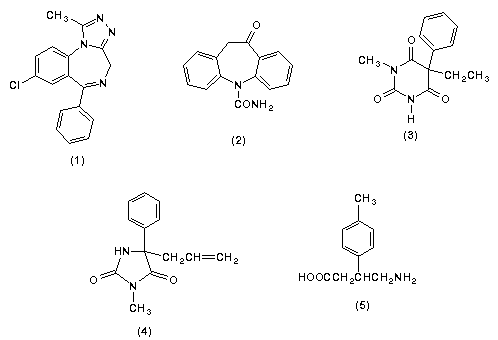
- 1. Match the drug structures with their structural classification.
- ( 5 ) Amino acid derivative
- ( 2 ) Dibenzazepine
- ( 4 ) Hydantoin
- ( 1 ) Tricyclic benzodiazepine
- ( 3 ) Barbiturate
- 2. List those drugs, by number, that will form a pharmaceutically-useful salt with HCl.
- Drug #1 and #5
- 3. those drugs, by number, that will form a pharmaceutically-useful salt with NaOH.
- Drug #3 and #5
- 4. Match the drug structures with ONE of the following therapeutic uses (note: a therapeutic use may be used more than once).
- ( 1 ) Anxiolytic
- ( 3 ) Sedative/hypnotic
- ( 2,4 ) Anti-epileptic
- ( 5 ) Muscle relaxant
- 5. Show the reaction of drug #1 with aqueous acid (H3O+).
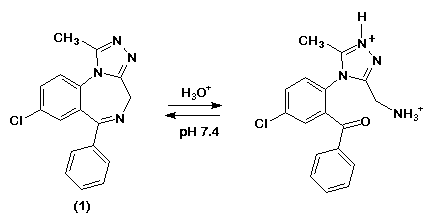
- 6. Comment on the therapeutic significance of this reaction.
- The tricyclic benzodiazepines, unlike the benzodiazepin-2-ones, are stable in aqueous acid therefore permitting formulation of aqueous parenteral dosage forms of these drugs.
- 7. Show the biotransformation of drug #2 (oxcarbazepine) to its active metabolite.
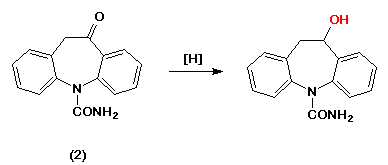
- 8. Explain the therapeutic advantage of oxcarbazaepine compared to its closely related analogue carbamazepine.
- Oxcarbazepine is metabolized to a pharmacologically-active metabolite while carbamazepine is metabolized to a toxic metabolite.
- 9. Draw the structure of one CYP450 oxidase metabolite of drug #3. Explain how interactions between drug #3 and other drugs metabolized by the same enzyme system may occur.
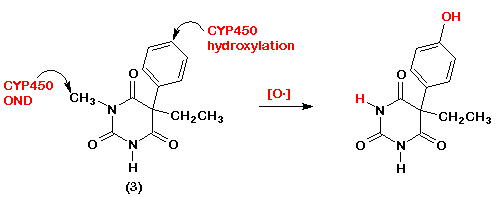
- Drug #3, a barbiturate derivative, is a potent inducer of hepatic oxidase drug metabolizing enzyme systems. Its use with other drugs metabolized by the same enzyme system can increase the usual clearance rate of these other drugs.
- 10. The duration of therapeutic action of drug #3 will likely be (check one answer):
- ( ) 1-4 hours
- ( X ) 4-12 hours
- ( ) 1-2 days
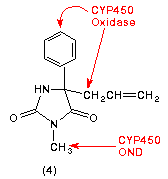
- 11. Draw the structure of two (2) different metabolites of drug #4 resulting from CYP450 oxidase biotransformation.
- 12. Describe how drug #4 is involved in competitive protein binding interactions with other drugs.
- OND of drug #4 produces an acidic metabolite (N-H) that is highly protein bound (lipophilic anion) and can compete with other protein bound drugs for these sites.
- 13. Drug #5 has a relatively short duration of action. Explain why and show the structure of an analogue of drug #5 that will likely have a longer duration of action.
- Short duration of action is related to rapid catabolism via CH3 oxidation.
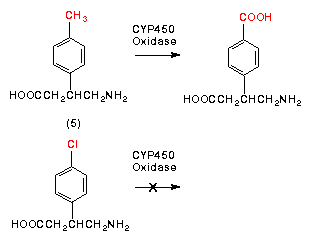
- Drug #5 is a 3-arylGABA derivative having muscle relaxant properties. Replacement of the metabolically labile p-CH3 group with metabolically-stable, lipophilic Cl should extend the metabolic half-life of the drug.
 Return to:
PY420 Home Page
Return to:
PY420 Home Page