Circle Packings of Random Planar Maps
LQG Motivation and Conformal Embeddings
Liouville quantum gravity (LQG) surfaces are random two-dimensional geometries that are expected, and in several settings known, to describe scaling limits of random planar maps coupled to statistical physics models. See (Berestycki & Powell, 2025) for a detailed introduction.
There are several ways to formulate convergence of random planar maps toward continuum random surfaces. One metric approach views the map as a finite metric-measure space, using graph distance and counting measure, and then asks for Gromov–Hausdorff–Prokhorov type convergence.
Another approach first embeds the planar map into the plane, sphere, or disk by a discrete conformal rule, then studies the limiting behavior of the embedded measure. Common embedding choices include Tutte embeddings (Gwynne et al., 2021), circle packings, Smith embeddings (Bertacco et al., 2025), and variants adapted to the topology or boundary conditions of the model.
Circle Packing
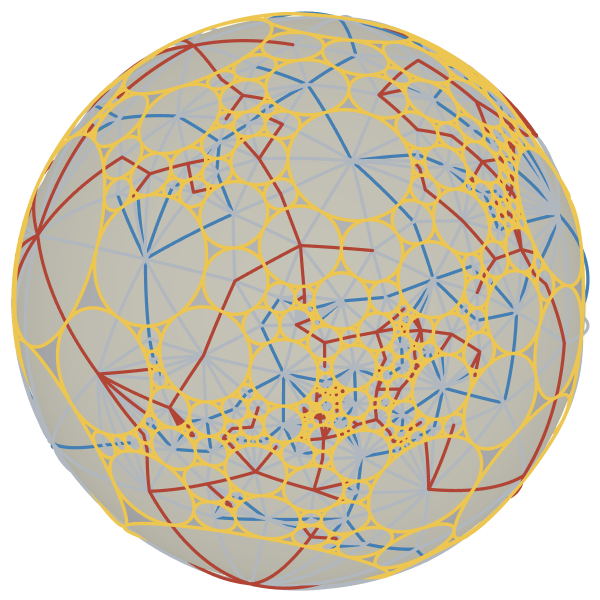
This simulation visualizes circle packings of several random planar map models. The image below shows a Schnyder-wood-decorated planar map with disk topology, whose three outer vertices give a natural boundary normalization. See also Jason Miller’s circle packings of mated-CRT maps with disk topology.
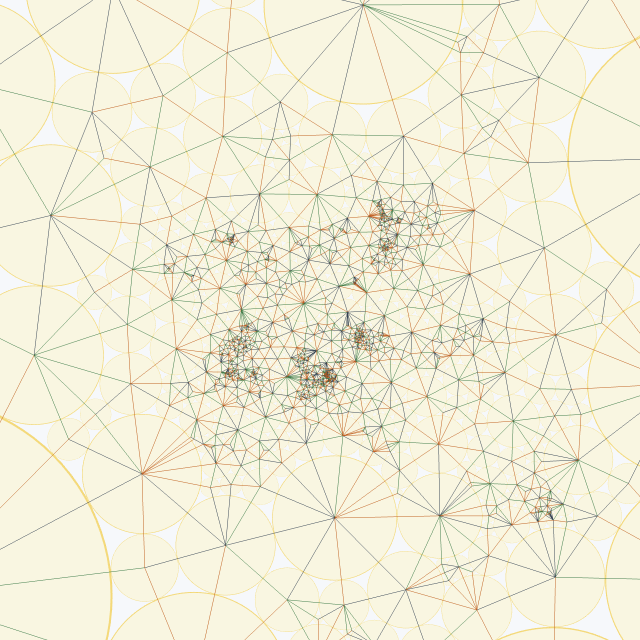
Adding the outer face turns the same combinatorics into a sphere-topology triangulation, which can be packed on the sphere. A Mobius transformation is then applied so that the barycenter of the circle centers is at the origin, spreading the packing more evenly across the sphere.
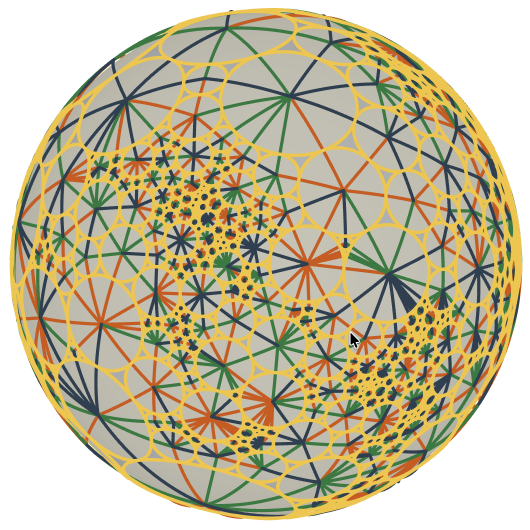
Use https://aub.ie/randcp for the live demo, including the preview image of uniform-spanning-tree decorated maps.
The basic input for circle packing is a triangulation. For finite triangulations of disk or sphere type, the Koebe–Andreev–Thurston circle-packing theorem gives a packing, unique up to the relevant conformal automorphisms after normalization.
For random planar maps, the guiding question is whether this discrete conformal embedding sees the same LQG geometry as other formulations. In forthcoming work, Holden–Yu prove that uniform-spanning-tree-decorated random planar maps converge to \(\sqrt{2}\)-LQG surfaces; see (Holden & Yu, 2026) for the setup for this result.