Exponentials of Log-Correlated Gaussian Fields
Exponentials of Log-Correlated Gaussian Fields
Liouville first passage percolation (LFPP) is a way to approximate random distances by exponentiating a regularized log-correlated Gaussian field and using the resulting weights to measure path length. In two dimensions, LFPP is closely tied to the construction and characterization of the LQG metric; for a survey, see (Ding, Dubédat, et al., 2023).
A natural experimental question is what similar exponential metric landscapes look like in higher dimensions. Ding–Gwynne–Zhuang prove tightness for natural exponential-metric approximations in arbitrary dimension in a subcritical regime (Ding, Gwynne, et al., 2023).
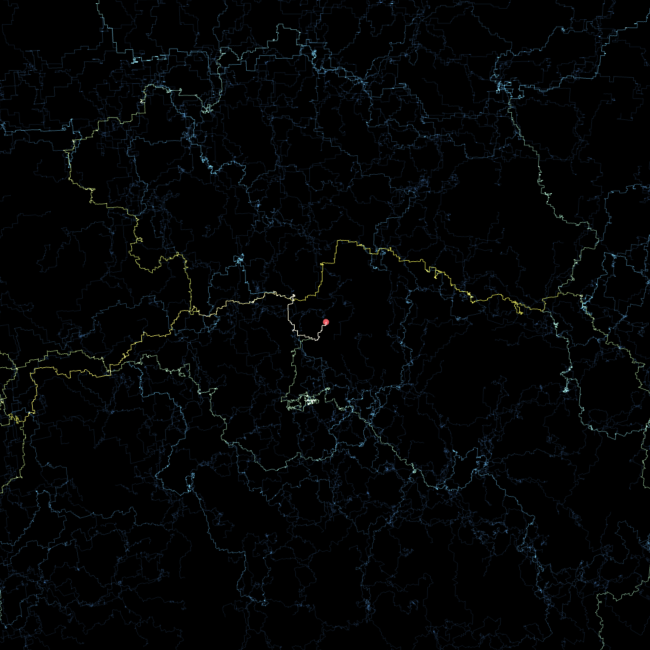
This simulation visualizes such metric structures in 3D, including random geodesics and filled metric balls. Use https://aub.ie/lfpp3d for the live demo.
Confluence of random geodesics in 3D
In two-dimensional LQG, unlike in smooth Riemannian geometry, geodesics from two different starting points to the same target can merge before reaching the target and then follow a common final segment. This phenomenon is called confluence, and Gwynne–Miller prove it rigorously for LQG metrics satisfying natural axioms (Gwynne & Miller, 2020).
The following simulation suggests that a similar confluence phenomenon may appear in the 3D exponential-metric model. At this point, it should be read as numerical evidence rather than a continuum theorem. Use https://aub.ie/confluence3d for the confluence demo.