Determinants
Lecture 20
Recap
$$ % Colors
% Coordinate vectors and matrices
% Common sets
% Abstract vector symbols
% Norms / absolute value
% Optional: dot product spacing (looks nicer in slides)
% Operators $$
Fundamental Subspaces
- Let \(A\) be an \(n\times m\) matrix. There are four fundamental subspaces.
- Column space \(C(A) \subseteq \mathbb{R}^n\) has dimension \(\mathop{\mathrm{rank}}(A)\).
- Row space \(C(A^T) \subseteq \mathbb{R}^m\) has dimension \(\mathop{\mathrm{rank}}(A)\).
- Nullspace \(N(A) \subseteq \mathbb{R}^m\) has dimension \(\mathop{\mathrm{null}}(A)\).
- Left nullspace \(N(A^T) \subseteq \mathbb{R}^n\) has dimension \(\mathop{\mathrm{null}}(A^T)\).
- Rank–nullity theorem:
\[\mathop{\mathrm{rank}}(A) + \mathop{\mathrm{null}}(A) = m,\qquad \mathop{\mathrm{rank}}(A) + \mathop{\mathrm{null}}(A^T) = n.\] - Rank measures how much essential information is encoded in the matrix.
Example
Let
\[A=\begin{bmatrix} 1 & 0 & 1 & -1 \\ 1 & 1 & 2 & 0 \\ 0 & 1 & 1 & 2\\ \end{bmatrix}.\]Compute the RREF of \(A\).
Use the pivot columns to find a basis for \(C(A)\).
Determine \(\mathop{\mathrm{rank}}(A)\).
Use the Rank–Nullity Theorem to compute \(\mathop{\mathrm{null}}(A)\).
Submit your nullity answer in iClicker.

Scan the QR code or go to join.iclicker.com/MBNJ.
Connection with Least Squares
- The system \(A\vec{x}=\vec{b}\) has a solution exactly when \(\vec{b}\in C(A)\).
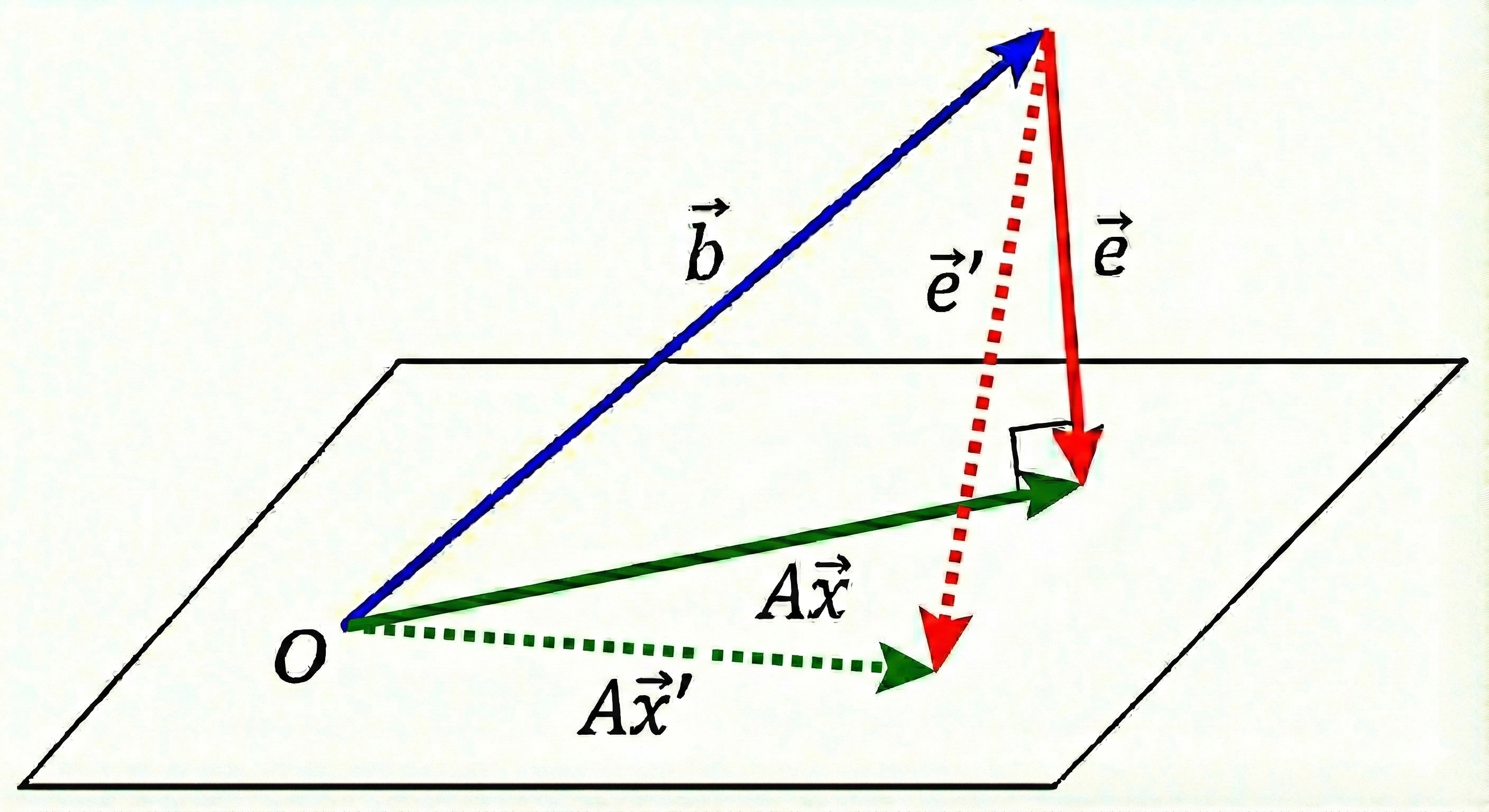
- If \(\vec{b}\notin C(A)\), then there is no exact solution, so we look for \(\vec{x}\) that minimizes the error \(\vec{e}=A\vec{x}-\vec{b}\). The error is minimized precisely when \(\vec{e}\) is orthogonal to the column space \(C(A)\).
- Orthogonality to \(C(A)\) is equivalent to \(A^T\vec{e}=\vec{0}\), so \(\vec{e}\in N(A^T)\), the left nullspace.
- Since \(\mathop{\mathrm{rank}}(A)+\mathop{\mathrm{null}}(A^T)=n\), the subspaces \(C(A)\) and \(N(A^T)\) are orthogonal complements that together fill \(\mathbb R^n\).
- Therefore, every vector \(\vec{b}\in\mathbb R^n\) can be uniquely written as \(\vec{b}=\vec{u}+\vec{e}\) with \(\vec{u}\in C(A)\) and \(\vec{e}\in N(A^T)\), which leads to the normal equations.
- In more advanced linear algebra, this is expressed as \(\mathbb R^n=C(A)\oplus N(A^T)\), a direct sum decomposition.
Least Squares Approximation
Determinants
Warm-up
- Recall the geometric interpretation of
\[A = [\vec{u}_1 \ \vec{u}_2] = \begin{bmatrix} a & b \\ c & d \end{bmatrix}\]
as a linear transformation on the plane. - This means the standard basis vectors are sent to \(\vec{e}_1 \mapsto \vec{u}_1 = \langle a,c \rangle\) and \(\vec{e}_2 \mapsto \vec{u}_2 = \langle b,d \rangle\).
- The new vectors \(\vec{u}_1, \vec{u}_2\) form a new coordinate grid.
- The whole plane is “deformed’’ according to how these two vectors move.
- Check Linear Transformations in 2D
Linear independence
- What happens if two non-zero vectors \(\vec{u}_1\) and \(\vec{u}_2\) are parallel (i.e. linearly dependent)?
- Then one vector is a scalar multiple of the other.
- Their span is only one-dimensional.
- The “grid’’ collapses to a line — all area is flattened.
- From RREF:
- If RREF\((A)=I_2\), then \(\mathop{\mathrm{rank}}(A)=2\) and the columns are linearly independent.
- Otherwise \(\mathop{\mathrm{rank}}(A)\le 1\), so the columns are linearly dependent.
Alternative way to check independence
- There is a geometric way to detect linear independence.
- Consider the area of the parallelogram formed by \(\vec{u}_1\) and \(\vec{u}_2\).
- If the area is zero, what does that mean?
- It means the vectors lie on the same line → they are linearly dependent.
- If the area is nonzero → they are linearly independent.
Area formed by two vectors
- Let \(A = [\vec{u}_1 \ \vec{u}_2] = \begin{bmatrix} a & b \\ c & d \end{bmatrix}\).
- The parallelogram formed by \(\vec{u}_1=\langle a,c \rangle\) and \(\vec{u}_2=\langle b,d \rangle\) has area \[\text{Area} = |ad - bc|.\]
- Check Geometric Proof.
Determinant of \(2\times2\) Matrix
- Let \(A=\begin{bmatrix} a & b \\ c & d \end{bmatrix}\).
- We define the determinant of \(A\) by \(\det(A)=\begin{vmatrix} a & b \\ c & d \end{vmatrix}=ad-bc\).
- The condition \(\det(A)=0\) holds if and only if the column vectors \(\vec{u}_1\) and \(\vec{u}_2\) are linearly dependent.
- The determinant measures signed area of the parallelogram formed by the columns of \(A\).
- The absolute value \(|\det(A)|\) gives the area, while the sign records the orientation (explained next).
Exercise
- Let \(A=\begin{bmatrix} 2 & 4 \\ 1 & 2 \end{bmatrix}\).
- Compute its determinant.
- Are the two column vectors linearly independent?
The Sign of the Determinant
- The geometric area of a parallelogram is always positive, but \(\det(A)\) may be positive or negative.
- For \(A=[\vec{u}_1\ \vec{u}_2]\), the sign of \(\det(A)\) records the orientation of the ordered pair \((\vec{u}_1,\vec{u}_2)\).
- If the smaller angle from \(\vec{u}_1\) to \(\vec{u}_2\) is counterclockwise, then \(\det(A)>0\) and the pair has positive orientation.
- If the smaller angle from \(\vec{u}_1\) to \(\vec{u}_2\) is clockwise, then \(\det(A)<0\) and the pair has negative orientation.
- The standard basis \(\{\vec{e}_1,\vec{e}_2\}\) has positive orientation, while \(\{\vec{e}_2,\vec{e}_1\}\) has negative orientation.
Orientations
- Right-hand rule: curl the fingers of your right hand from \(\vec{u}_1\) toward \(\vec{u}_2\) through the smaller angle; if your thumb points toward you, the orientation is positive, and if it points away from you, the orientation is negative.
- If two coordinate systems have the same orientation, one can be continuously deformed into the other without collapsing area.
- If they have opposite orientation, a “flip’’ is required to pass from one to the other.
- Explore this visually at Orientation and Sign of the Determinant.
- Swapping the two columns of \(A\) reverses the orientation and changes the sign of the determinant.
Area Ratio
- A linear transformation scales area uniformly across the plane.
- Every unit square in the original grid is transformed into the same parallelogram determined by the column vectors of \(A\).
- Since total area is computed by assembling many tiny squares (the idea behind integration), the entire area scales by a single constant factor.
- That constant scaling factor is \(|\det(A)|\).
- The sign of \(\det(A)\) does not affect area size, but it determines whether the transformation preserves or reverses orientation.
- Explore this visually at Linear Transformations in 2D.
Example
- The area of a unit circle is \(\pi\).
- For \(a, b>0\), consider the linear transformation \[A=\begin{bmatrix} a & 0 \\ 0 & b \end{bmatrix}.\]
- This stretches by factor \(a\) in the \(x\)-direction and \(b\) in the \(y\)-direction.
- The determinant is \[\det(A)=ab.\]
- The unit circle transforms into an ellipse with semi-axes \(a\) and \(b\).
- Since area scales by \(\det(A)\), the new area is \(\pi ab\).
Determinants for \(3\times3\) Matrices
- The determinant idea extends naturally to higher dimensions.
- Let \(A=[\vec{u}_1\ \vec{u}_2\ \vec{u}_3]\) be a \(3\times3\) matrix with column vectors \(\vec{u}_i\in\mathbb R^3\).
- The determinant \(\det(A)\) measures the signed volume of the parallelepiped formed by \(\vec{u}_1,\vec{u}_2,\vec{u}_3\).
- If this volume is nonzero, the three vectors form a genuine three-dimensional grid and are linearly independent.
- If the volume is zero, the grid collapses into a plane or even a line, so the vectors are linearly dependent.
- You can visualize this at Linear Transformations in 3D.
- Therefore, \(\det(A)\) provides a test for linear independence in \(\mathbb R^3\).
- The explicit formula is more complicated than in the \(2\times2\) case; we will develop it using cofactor expansion next class.