Post Break Review
Lecture 24
Auburn University
MATH 2660 - Spring 2026
March 16, 2026
Welcome back 🏖️
$$ % Colors
% Coordinate vectors and matrices
% Common sets
% Abstract vector symbols
% Norms / absolute value
% Optional: dot product spacing (looks nicer in slides)
% Operators $$
Let’s catch up
- Share with your classmates what you did over spring break.
- Did you discover any hidden gems around Auburn?
Announcements
- The midterm feedback form closes tonight. Feel free to leave anonymous comments if you have any feedback.
- Quiz 2 results are now available in Canvas Grades. Once all accommodated quizzes are completed (expected by Friday), you will also be able to review your answers. I am happy to award generous bonus points for minor mistakes (for example, computing \(\mathrm{proj}_{\mathbf{u}}\mathbf{v}\) instead of the requested quantity), so please submit those requests later next week.
- Per your request, Canvas Grades now shows totals after dropping the lowest quiz and homework score. Please remember that final letter grades will still be curved as described in the syllabus.
- Please keep the remaining assessments in mind: Quiz 3 (Apr 10), Final 1 (Apr 24), and Final 2 (Apr 27). Let me know as soon as possible if you have any scheduling conflicts.
- The books for Bonus Assignment 1 are now available through the library in both physical and electronic formats.
Recap
Overview
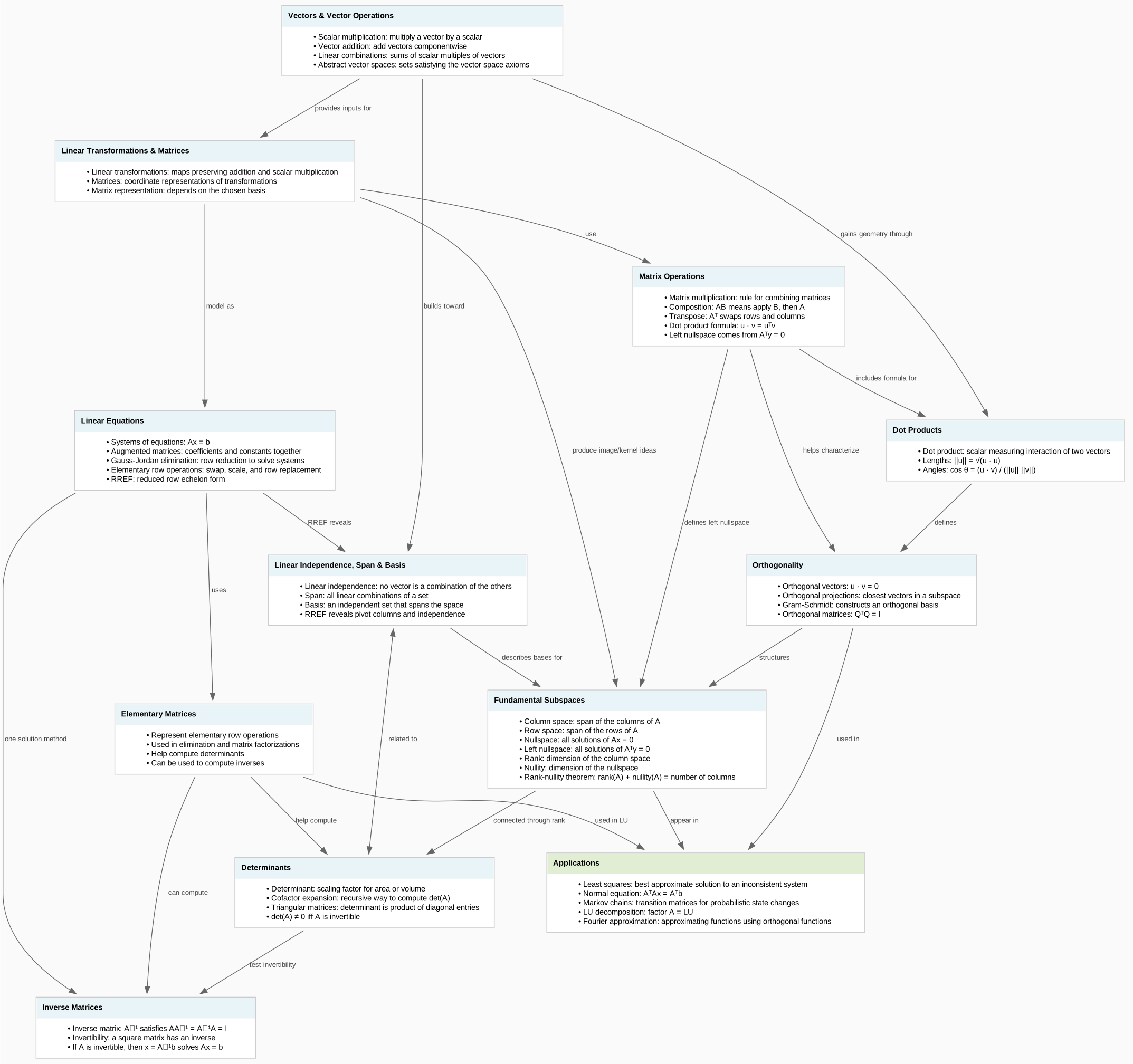
Determinants
- For an \(n \times n\) matrix \(A\):
- \(\det(A)\) can be computed by cofactor expansion along any row or column. In practice, choose one with many zeros to simplify the computation.
- \(|\det(A)|\) equals the hypervolume of the parallelepiped formed by the \(n\) column vectors.
- The sign of \(\det(A)\) records the orientation of the column vectors.
- If \(\det(A)=0\), the columns are linearly dependent.
- If \(\det(A)\neq 0\), the columns are linearly independent and \(A\) is invertible.
Homogeneous linear equations
- Let \(A = [\vec{u}_1 \cdots \vec{u}_n]\) be an \(n \times n\) matrix with columns \(\vec{u}_i \in \mathbb{R}^n\).
- The system \(A\vec{x} = \vec{0}\) has a unique solution \(\vec{x}=\vec{0}\) if:
- the vectors \(\vec{u}_i\) are linearly independent
- \(\mathrm{RREF}(A) = I_n\)
- \(\det(A) \ne 0\)
- The system \(A\vec{x} = \vec{0}\) has infinitely many solutions if:
- the vectors \(\vec{u}_i\) are linearly dependent
- \(\mathrm{RREF}(A) \ne I_n\)
- \(\det(A) = 0\)
Example
- Let \[
A=\begin{pmatrix}
1 & 2 & 1\\
2 & 4 & 2\\
1 & 1 & 0
\end{pmatrix}.
\] Determine how many solutions there are for \(A\vec{x}=\vec{0}\) by
- computing \(\det(A)\)
- using the Gauss-Jordan elimination.
- Using elementary matrices used in the previous part, recover \(\det(A)\).
- Find a basis of the nullspace \(N(A)\) by solving the equation.
Solution
Let \(\vec{x}=\begin{pmatrix}x_1\\x_2\\x_3\end{pmatrix}\).
Using the determinant: Expand along the first row: \[ \det(A)= 1\begin{vmatrix}4&2\\1&0\end{vmatrix} -2\begin{vmatrix}2&2\\1&0\end{vmatrix} +1\begin{vmatrix}2&4\\1&1\end{vmatrix} =1(0-2)-2(0-2)+(2-4)=0. \] Since \(\det(A)=0\), \(A\) is singular, so the homogeneous system \(A\vec{x}=\vec{0}\) has infinitely many solutions.
Using Gauss-Jordan: \[ \begin{pmatrix} 1&2&1\\ 2&4&2\\ 1&1&0 \end{pmatrix} \xrightarrow{R_2\to R_2-2R_1} \begin{pmatrix} 1&2&1\\ 0&0&0\\ 1&1&0 \end{pmatrix} \xrightarrow{R_3\to R_3-R_1} \begin{pmatrix} 1&2&1\\ 0&0&0\\ 0&-1&-1 \end{pmatrix} \] \[ \xrightarrow{R_3\to -R_3} \begin{pmatrix} 1&2&1\\ 0&0&0\\ 0&1&1 \end{pmatrix} \xrightarrow{R_1\to R_1-2R_3} \begin{pmatrix} 1&0&-1\\ 0&0&0\\ 0&1&1 \end{pmatrix} \xrightarrow{R_2\leftrightarrow R_3} \begin{pmatrix} 1&0&-1\\ 0&1&1\\ 0&0&0 \end{pmatrix}. \] There is one free variable, so again \(A\vec{x}=\vec{0}\) has infinitely many solutions.
Recovering \(\det(A)\) from elementary matrices: The row operations above were:
- \(R_2\to R_2-2R_1\) (determinant factor \(1\))
- \(R_3\to R_3-R_1\) (determinant factor \(1\))
- \(R_3\to -R_3\) (determinant factor \(-1\))
- \(R_1\to R_1-2R_3\) (determinant factor \(1\))
- \(R_2\leftrightarrow R_3\) (determinant factor \(-1\))
So if \(E_5E_4E_3E_2E_1A=R\), then \[ \det(R)=\det(E_5)\det(E_4)\det(E_3)\det(E_2)\det(E_1)\det(A). \] Here \[ \det(E_5)\det(E_4)\det(E_3)\det(E_2)\det(E_1)=(-1)(1)(-1)(1)(1)=1. \] Hence \(\det(R)=\det(A)\). But \(R\) has a zero row, so \(\det(R)=0\). Therefore \(\det(A)=0\).
Finding a basis of \(\mathop{\mathrm{null}}(A)\): From the RREF, \[ \begin{aligned} x_1-x_3&=0,\\ x_2+x_3&=0. \end{aligned} \] Let \(x_3=t\). Then \[ x_1=t,\qquad x_2=-t,\qquad x_3=t. \] Therefore \[ \vec{x}=t\begin{pmatrix}1\\-1\\1\end{pmatrix}. \] So \[ N(A)=\mathop{\mathrm{span}}(\left\{\begin{pmatrix}1\\-1\\1\end{pmatrix}\right\}), \] and a basis is \[ \left\{\begin{pmatrix}1\\-1\\1\end{pmatrix}\right\}. \]
This week’s plan
- Next class we will discuss some applications of determinants (Cramer’s rule, cross product, etc). Please review the cofactor formula for determinants (especially for \(3\times 3\) matrices), their geometric meaning, and how to compute determinants using elementary matrices from Gauss–Jordan elimination.
- This week’s homework will cover determinants and their applications. It will be due by Friday and may overlap with Quiz 2 if you want to start early.
- On Friday we will begin a new topic: eigenvalues and eigenvectors. Please review the relationship between solutions of linear systems and determinants.

Comments