Decorated Random Planar Maps
This entry is currently a work in progress. More details, references, and simulation notes will be added soon.
Many random planar map models become easier to study after keeping track of extra combinatorial structure. A spanning tree, bipolar orientation, Schnyder wood, FK configuration, Hamiltonian path, or loop ensemble is not just a visual overlay: it often gives an encoding of the map by a walk, a pair of trees, or another lower-dimensional object.
A decorated planar map is a pair \((M,D)\), where \(M\) is a planar map and \(D\) is a statistical-physics or combinatorial decoration on top of it. Sampling uniformly from decorated pairs is equivalently sampling the underlying map with weight given by the number, or partition function, of compatible decorations.
The guiding question is whether these decorated random maps converge to Liouville quantum gravity (LQG) surfaces decorated by SLE- or CLE-type objects. The mating-of-trees framework is a central tool: discrete bijections encode decorated maps by two-dimensional walks, while the continuum theory encodes SLE-decorated LQG surfaces by correlated Brownian motions (Duplantier et al., 2021; Gwynne et al., 2023).
Known Models
Use https://aub.ie/randmaps for the live demo.
Uniform Random Planar Maps
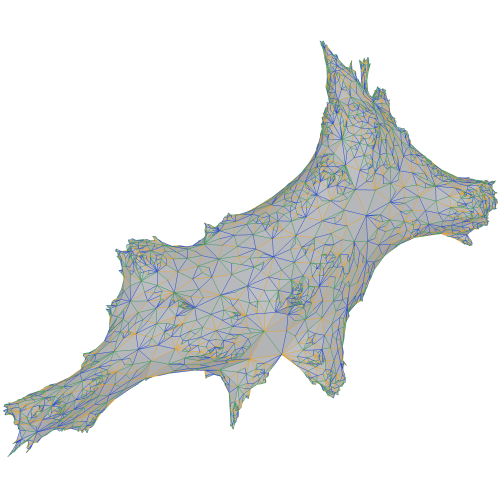
Uniform random planar maps, without extra statistical-physics decoration, belong to the pure-gravity universality class. Their metric scaling limit is the Brownian map in many settings (Le Gall, 2013), and the Brownian map is identified with the \(\gamma=\sqrt{8/3}\) LQG sphere in the Miller–Sheffield program (Miller & Sheffield, 2020).
Uniform-Spanning-Tree-Decorated Random Planar Maps
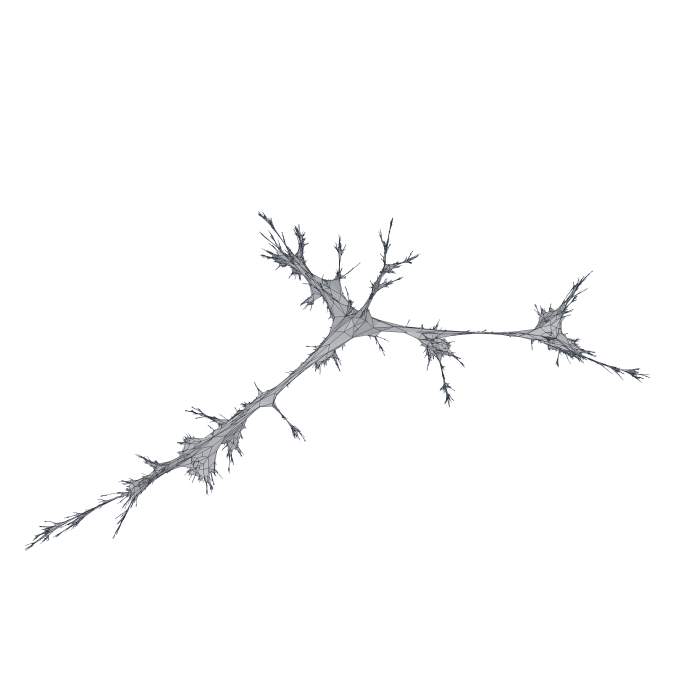
Tree-decorated planar maps go back to Mullin’s enumeration of tree-rooted maps (Mullin, 1967). In the LQG dictionary, uniform-spanning-tree-decorated maps are associated with \(\gamma=\sqrt{2}\). The mating of trees demo illustrates the walk/tree encoding behind this viewpoint.
FK-Decorated Random Planar Maps
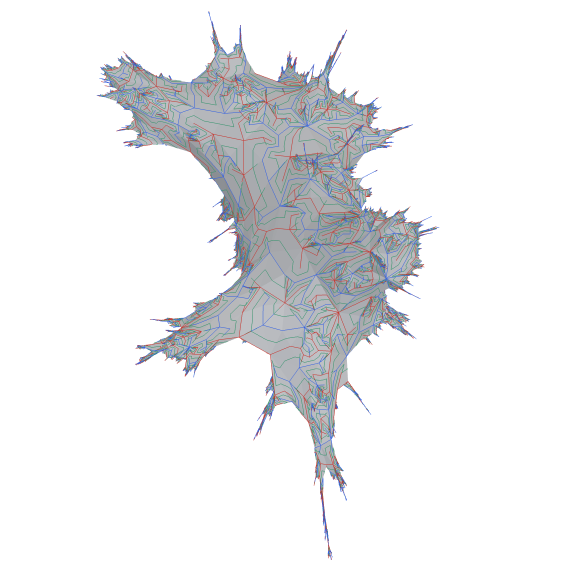
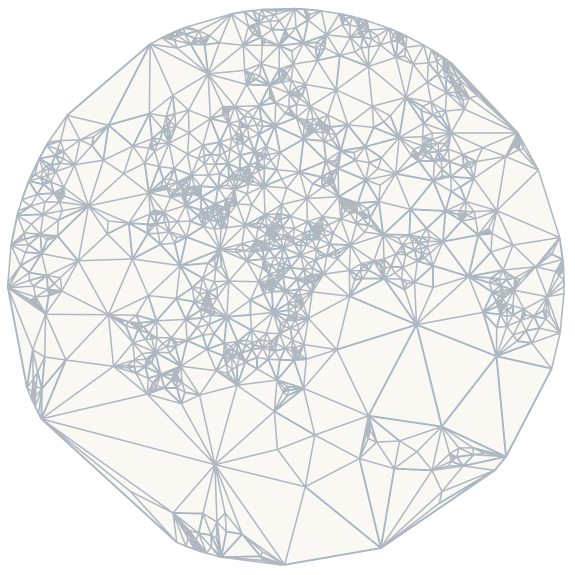
FK-decorated maps add a random-cluster configuration to the planar map. Sheffield’s hamburger-cheeseburger bijection is a central example of how such decorated maps can be encoded by a two-dimensional walk (Sheffield, 2016).
Schnyder-Wood-Decorated Random Planar Maps
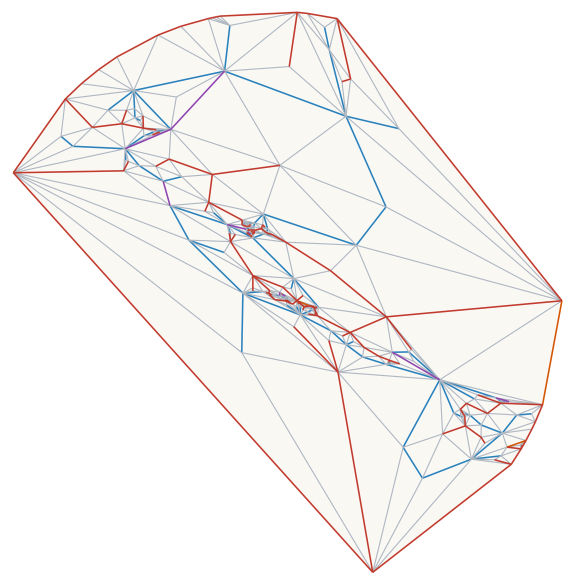
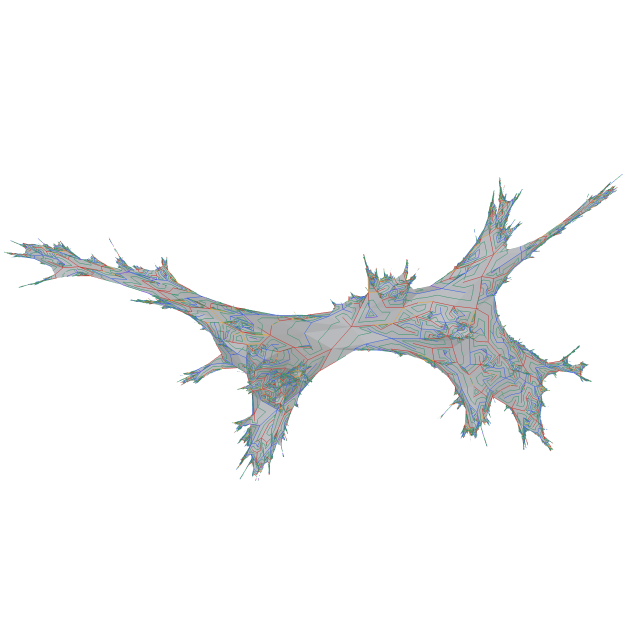
A Schnyder wood decomposes a triangulation into three oriented tree-like structures. Li–Sun–Watson identify the mating-of-trees scaling picture for uniformly sampled Schnyder-wood-decorated triangulations, relating the model to \(\gamma=1\) LQG decorated by a triple of SLE\(_{16}\)-type curves (Li et al., 2024).
Meandric System-Decorated Random Planar Maps
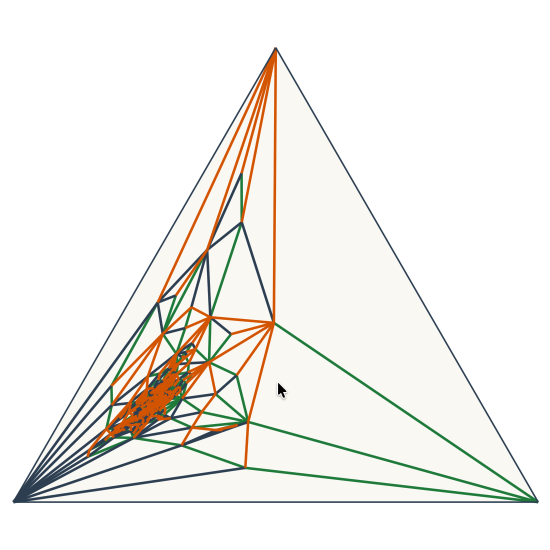
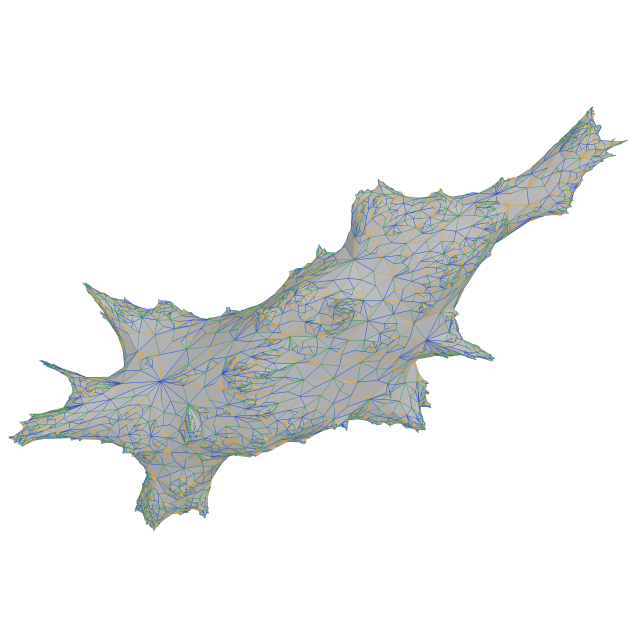
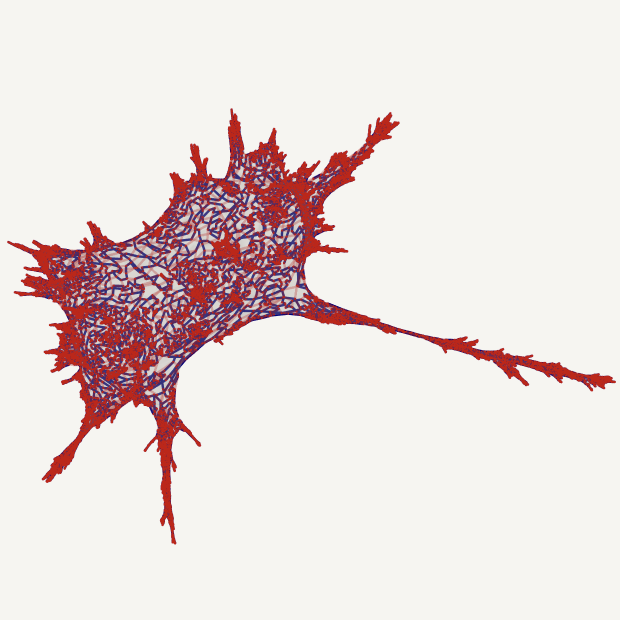
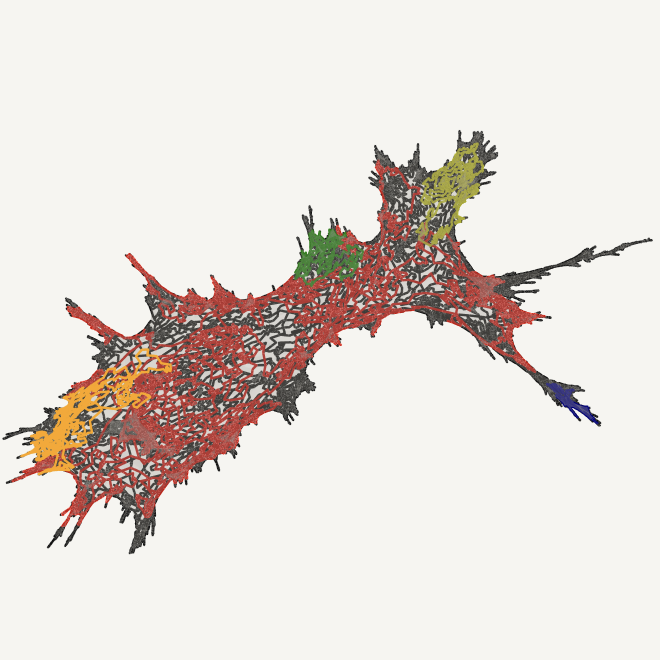
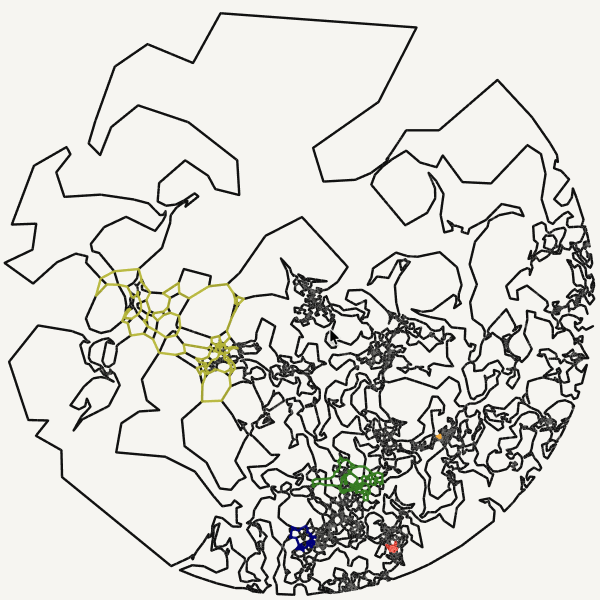
Meanders and meandric systems can be viewed as planar maps decorated by a Hamiltonian path and a collection of loops. For uniform meandric systems, the predicted scaling picture is a \(\sqrt{2}\)-LQG sphere decorated by a space-filling SLE\(_8\) and CLE\(_6\); see Borga–Gwynne–Park for geometric results consistent with this picture (Borga et al., 2023). For uniform meanders, the related permuton conjecture points to two independent space-filling SLE\(_8\) curves on a \(\gamma=\sqrt{\frac{17-\sqrt{145}}{3}}\)-LQG surface (Borga et al., 2025). See Meandric Maps for the dedicated gallery entry.
Models To Add
- Bipolar-oriented maps
- \(O(n)\)-loop-decorated maps
These and other walk-encoded models fit naturally into the same overview. They can be added here once their visual assets are ready; the mating-of-trees survey gives a common reference frame for many of these examples (Gwynne et al., 2023).