Meandric Maps
Meanders and Meandric Systems
Use https://aub.ie/meandric for the live demo.
A meandric system of size \(n\) is formed from two non-crossing perfect matchings on \(\{1,\ldots,2n\}\), one drawn above the real line and one below it. Equivalently, it can be viewed as a planar map decorated by a Hamiltonian path and a collection of loops. A meander is the special case where the two matchings form a single loop.
For uniform meandric systems, the predicted scaling picture is a \(\sqrt{2}\)-LQG sphere decorated by a space-filling SLE\(_8\) and CLE\(_6\); see Borga–Gwynne–Park for geometric results consistent with this prediction (Borga et al., 2023). For uniform meanders, the related conjecture points to two independent space-filling SLE\(_8\) curves on a \(\gamma=\sqrt{\frac{17-\sqrt{145}}{3}}\)-LQG surface (Borga et al., 2025).
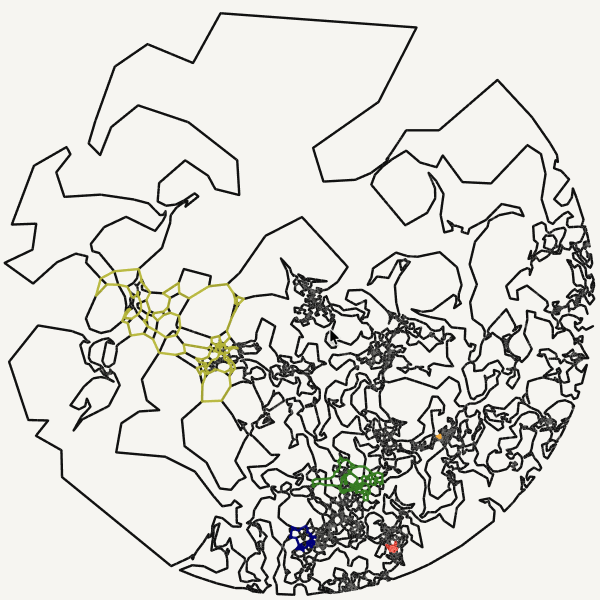
Uniform Meanders
In the meander case, the union of the upper and lower arc diagrams is connected to form a single loop.
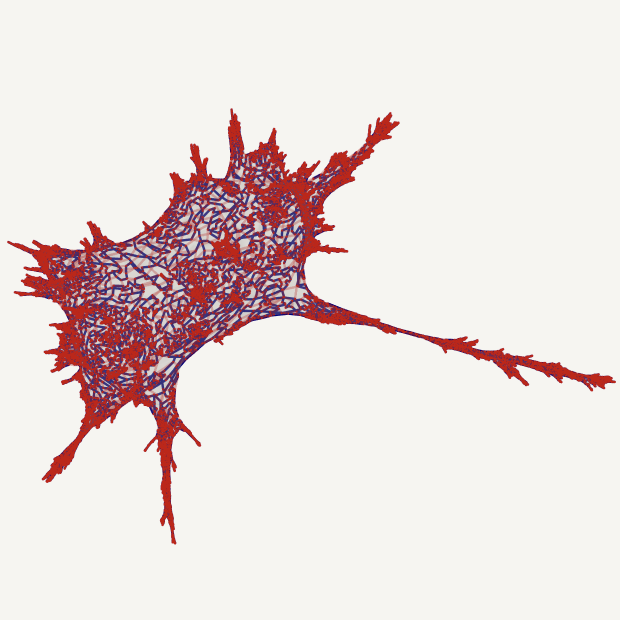
Uniform Meandric Systems
For a meandric system, the same construction may produce many loops. The large loops and their interaction with the Hamiltonian path are the main geometric features to inspect.
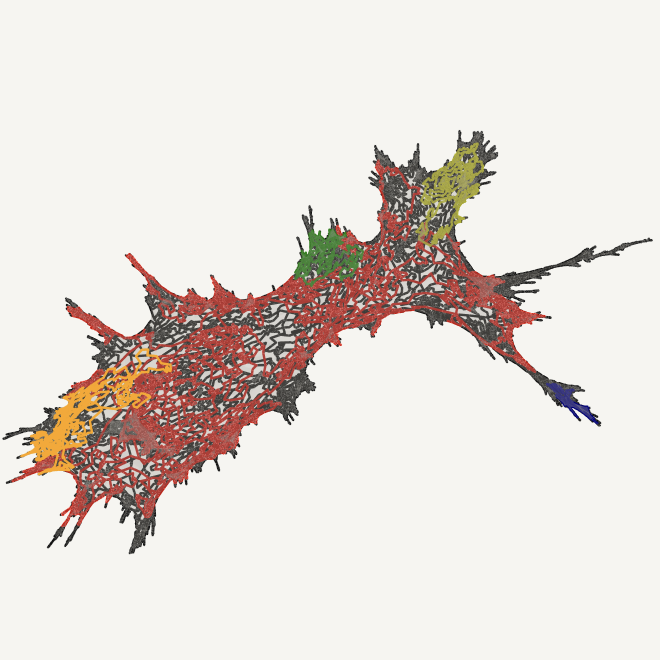
Uniform Half-Plane Meandric Systems
The half-plane version gives the disk topology of the same loop-decorated geometry.