LQG Surfaces from Mated-CRT Maps
LQG Surfaces
Liouville quantum gravity (LQG) surfaces are random two-dimensional geometries that arise as canonical scaling limits of many planar-map models, especially when the maps are coupled to statistical physics decorations.
One mathematical starting point is the random metric tensor formally written as \(e^{\gamma h(z)}\,(dx^2+dy^2)\), where \(h\) is a log-correlated Gaussian field and the exponential must be defined by regularization. See (Berestycki & Powell, 2025) for a detailed construction.
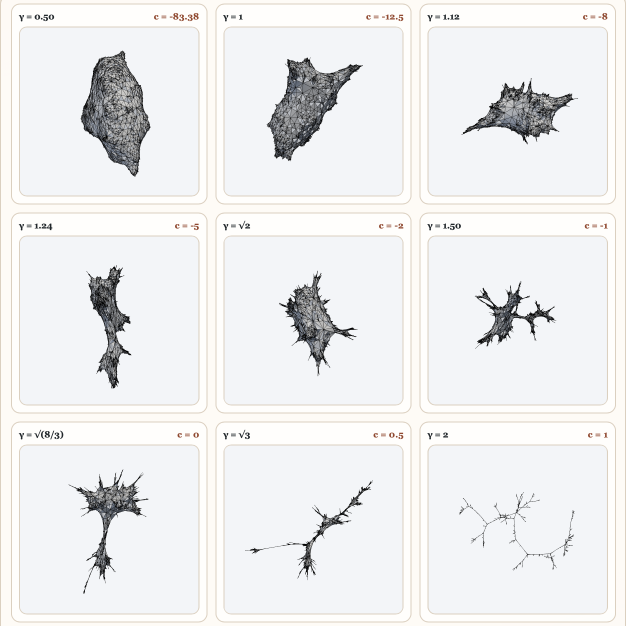
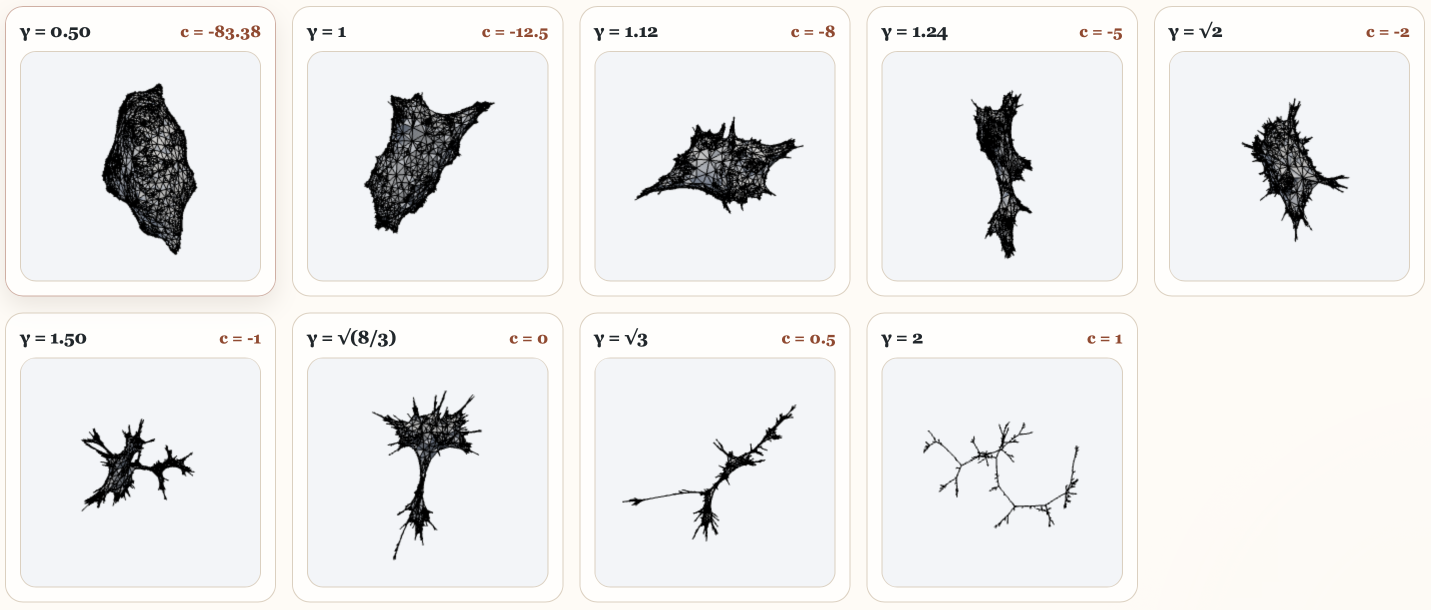
In the physics notation, the parameter \(\gamma \in (0,2]\) is often traded for the matter central charge \(c = 25 - 6Q^2\), where \(Q = 2/\gamma + \gamma/2\). For example, \(\gamma=\sqrt{8/3}\) corresponds to \(c=0\), the pure gravity/Brownian map case. The value \(\gamma=\sqrt{2}\) corresponds to \(c=-2\), the uniform-spanning-tree-decorated map case.
Physics Heuristic
A useful informal picture is that LQG surfaces are pure-gravity surfaces reweighted by a factor \((\det \Delta)^{-c/2}\), where \(\Delta\) is a Beltrami-Laplace operator, in the spirit of Polyakov’s path-integral formulation of random surfaces (Polyakov, 1981). When \(c=-2\), this becomes a single power of the determinant. On a finite graph, Kirchhoff’s matrix-tree theorem identifies an appropriate Laplacian determinant with the number of spanning trees. In this sense, the \(c=-2\) case can be viewed as a planar map decorated by the uniform spanning tree.
This determinant heuristic is not a definition of the sampled objects, but it gives useful visual guidance: changing the central charge changes the determinant weight, and hence changes which combinatorial structures are favored. Since a tree has exactly one spanning tree, larger values of \(c\) heuristically favor maps with fewer spanning trees, making the sampled geometry look more tree-like.
Mated-CRT Sphere Approximation
Use https://aub.ie/matedcrt for live demo with animations.
The table above approximates LQG sphere geometries using mated-CRT maps with sphere topology. These maps are built from a correlated pair of continuum random trees, equivalently from the peanosphere, or mating-of-trees, encoding (Duplantier et al., 2021; Gwynne et al., 2023).
Mated-CRT Disks
The disk-topology version is visible in Jason Miller’s Tutte-embedding simulations, which include mated-CRT maps embedded in the unit disk. Adding boundary vertices gives a finite map with boundary, so the Tutte embedding can be normalized against the disk boundary. In this setting, Gwynne–Miller–Sheffield prove that the Tutte embedding of the mated-CRT map converges to the corresponding LQG surface (Gwynne et al., 2021).